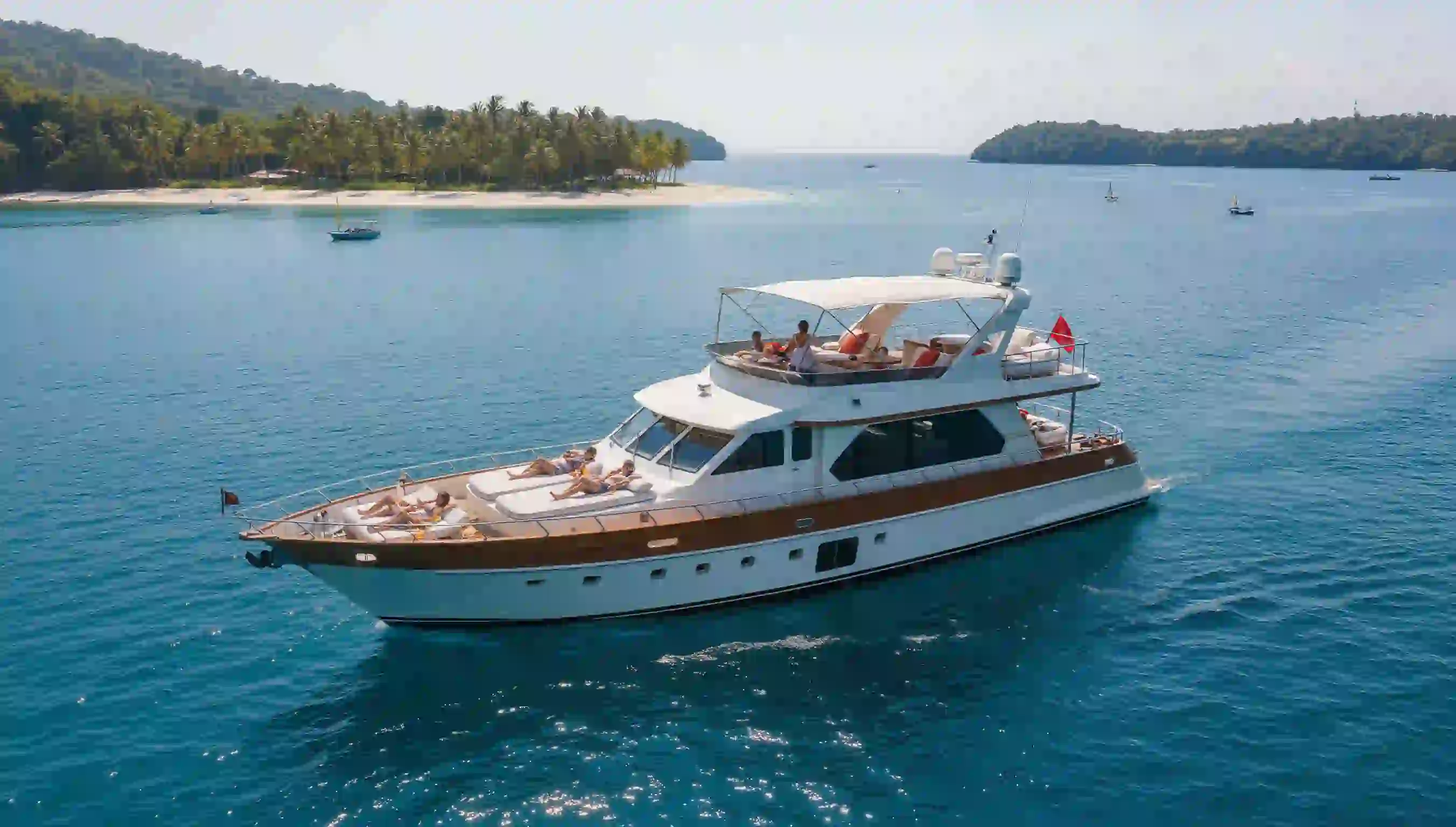
Chartering vs Owning a Yacht in Bali: The Real Cost Math

If you spend fewer than six to eight weeks a year on the water in Indonesia, chartering is almost always the cheaper option, and the gap is not small. The long-standing rule of thumb puts annual running costs at roughly 10 percent of a yacht’s purchase price, so a USD 1 million vessel typically absorbs USD 100,000 or more a year in crew, berthing, maintenance, insurance, and management before it has moved an inch. Charter a comparable boat for twenty days a year and you will usually spend well under that, with no capital tied up and no depreciation working against you.
Ownership starts to make sense once usage climbs past that threshold. One note on where we sit: we are a charter curation and booking desk that arranges vessels through our group’s operators; our sibling brokerage desk handles purchase-side work, so we see both ledgers and have no reason to flatter either one.
The ownership cost stack in Indonesia
The 10 percent rule is a starting point, not a ceiling. Indonesia has its own line items, some cheaper than Europe, some structural:
- Acquisition and flag. Foreign-flagged yachts can cruise privately under Indonesia’s simplified entry rules, but commercial charter requires an Indonesian-flagged vessel owned through an Indonesian entity; cabotage rules apply. Import duty, VAT, and notarial work push landed cost well above the sticker price; budget for professional help here.
- Crew payroll. This is the one line where Indonesia is genuinely favorable. A crewed 24 to 30 meter motor yacht or phinisi typically carries five to seven crew. Indicative monthly wages: captain USD 1,000–2,500, engineer USD 700–1,500, deckhands USD 300–600 each, chef USD 500–1,200. With social security, food, uniforms, and rotation cover, a realistic annual payroll lands around USD 45,000–85,000, running twelve months whether you board the boat or not.
- Berthing. Bali has very limited proper berthing. Benoa Harbour is the main hub and Serangan absorbs overflow, but full-service marina berths are scarce, which is why many owners base vessels in Lombok, Phuket, or Singapore and reposition for the season. Indicative Indonesian marina rates run USD 10–25 per meter per month, so a 30 meter yacht pays roughly USD 4,000–9,000 a year locally; Singapore runs a multiple of that. Confirm berthing before purchase, not after.
- Maintenance, insurance, and management. The tropics are hard on boats; most owners budget 2–5 percent of vessel value yearly for maintenance and an annual haul-out, plus hull and machinery insurance around 0.8–1.5 percent of insured value. Management, unless you handle crew and compliance yourself, runs roughly USD 2,000–6,000 a month.
What frequent chartering actually costs
Charter pricing is refreshingly simple: one day rate, crew and vessel included, and the meter only runs when you are aboard. In Bali, well-kept luxury day boats generally run USD 1,000–3,500 per day, larger motor yachts and premium phinisi USD 3,500–10,000 per day, and true superyachts above that; our Bali superyacht charter page covers the top end in detail. Multi-day Komodo routes are quoted per night, crew and meals included. Our charter cost guide for 2027 breaks down what is included at each price band.
The break-even math
Take a concrete case: a USD 1 million, 30 meter crewed vessel kept in Indonesia, against chartering an equivalent boat at USD 3,500 a day. Indicative annual figures:
| Cost line | Owning (per year) | Chartering 20 days (per year) |
|---|---|---|
| Crew payroll and related | USD 45,000–85,000 | Included in day rate |
| Berthing and mooring | USD 5,000–15,000 | Included |
| Maintenance and yard | USD 25,000–50,000 | Included |
| Insurance | USD 8,000–15,000 | Included |
| Management and admin | USD 24,000–60,000 | None |
| Depreciation (indicative 5–8%) | USD 50,000–80,000 | None |
| Annual total | USD 157,000–305,000 | ~USD 70,000 |
Read it the other way: at USD 3,500 a day, you could charter roughly 45 to 85 days a year before matching what ownership costs annually, before even counting the capital’s opportunity cost. Even a heavy user on the water six weeks a year in Indonesia is usually still ahead by chartering.
When owning does make sense
The math flips in a few situations: genuine use of eight or more weeks a year, a need for a specific configuration that charter inventory does not offer, or a plan to place the boat into commercial charter to offset costs. Revenue from charter weeks can cover a substantial share of running costs, though it rarely erases them, and no honest broker or operator will promise a guaranteed return; charter income in Indonesia is seasonal and depends on marketing and vessel condition.
Serious about buying? Start with the brokerage desk
If your usage or ambitions point toward ownership, start with a clear-eyed conversation about total cost, not a boat viewing. Our sibling desk at Bali Yacht Broker publishes a full breakdown of what a yacht broker in Bali costs and what that fee covers: survey coordination, flag and import strategy, entity setup, and negotiation. Do that math first, and you buy an asset, not a liability.
And if the numbers land on the charter side for you, as they do for most people, we can put you on the water this season with no fixed cost. Browse the fleet on our superyacht charter page, or talk through routes and dates on WhatsApp at +62 811-3941-4563 or by email at bd@juaraholding.com.