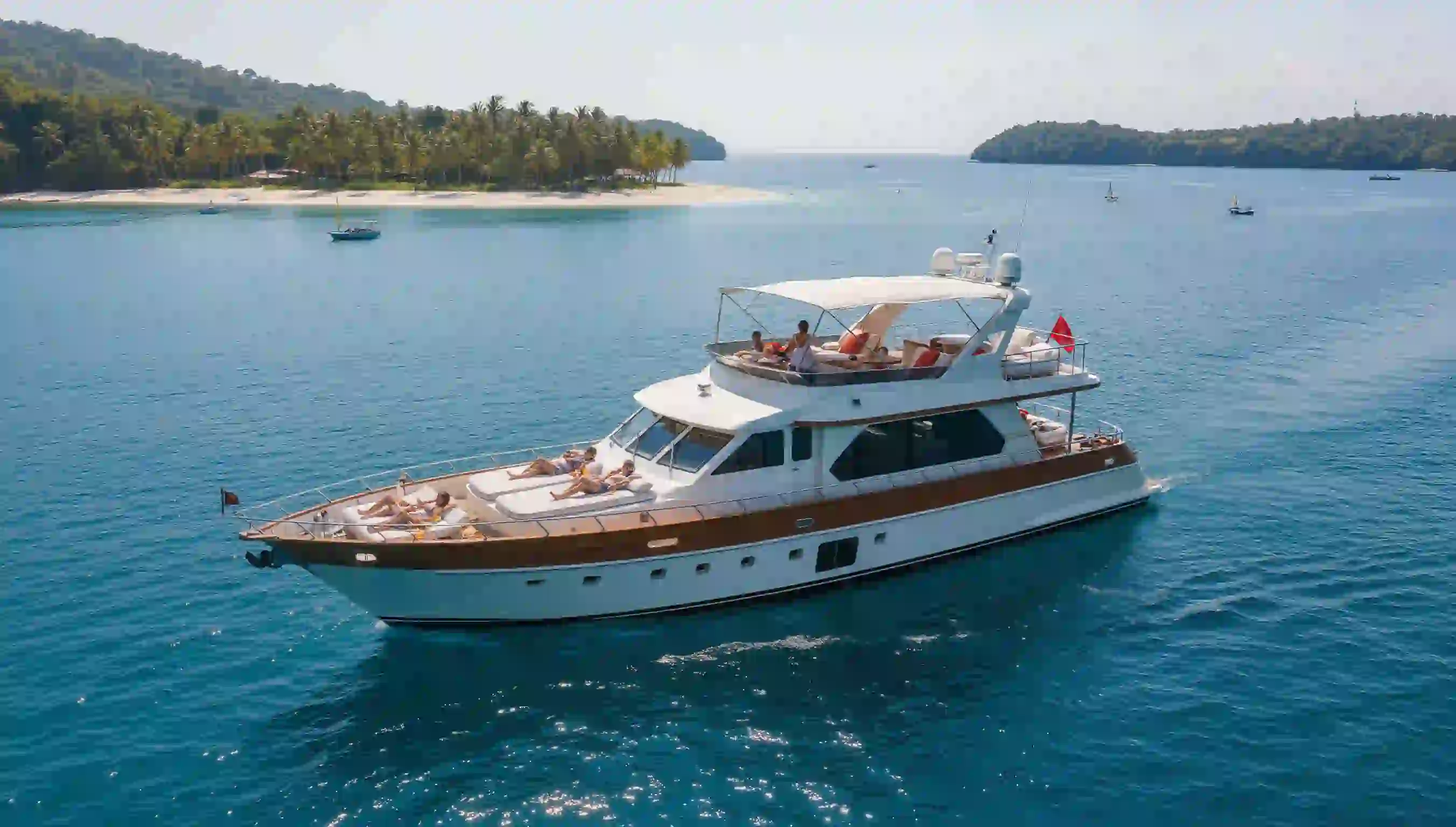
Wi-Fi and Connectivity on Bali Yacht Charters: What to Expect at Sea
Close to the Bali coast, your phone does most of the work: Indonesian 4G covers Benoa Harbour, Sanur, and Nusa Dua well enough that a Telkomsel SIM usually holds signal five to eight kilometres offshore, and a sunset cruise rarely breaks a video call. That changes once the bow points further out. Mid-strait toward Nusa Penida, signal thins or drops, and on multi-day routes to Komodo, assume the network is absent unless the boat carries a satellite link.
So the real question in 2026 is not whether there is Wi-Fi on board, but what kind: a 4G router rebroadcasting shore towers your phone already sees, or a Starlink terminal that keeps working far from any tower. Since Starlink’s Indonesian licence in 2024, uptake has been concentrated in the upper tiers: superyachts, premium phinisi, and newer motor yachts. Day boats and open speedboats still rely on the phone in your pocket.
Signal reality, route by route
Benoa, Sanur, and the south Bali coastline
This is the easy zone. Towers serving Denpasar, Sanur, and the Bukit peninsula reach past the reef line, so day cruises hugging the coast sit in 4G almost the entire time. On a sunset cruise out of Benoa, connectivity is rarely worth a second thought.
The crossing to Nusa Penida and Nusa Lembongan
The Badung Strait is roughly a 20-kilometre crossing, and its middle is where phones start to struggle: expect weak or absent signal for 20 to 40 minutes before coverage returns. Around Penida, coverage is uneven; Toyapakeh and the Lembongan channel are usually fine, while spots beneath the high western cliffs, such as Crystal Bay, sit in a radio shadow. If a call matters, tell the crew in the morning so they can time the crossing.
Bali to Komodo and the eastern islands
This is where cellular planning stops working. A private yacht charter from Bali to Komodo covers roughly 250 nautical miles through Lombok and Sumbawa, with network reappearing only near ports. Inside the national park, Labuan Bajo has solid 4G, but anchorages such as Padar and the manta channels are dead zones. Here the vessel’s own equipment is the only variable: without satellite internet, expect days offline; with Starlink, a video call at anchor off Padar is possible.
The three systems that keep a boat online
Marine 4G routers. The common mid-range setup pairs a router with an external antenna mounted high on the mast, stretching usable range well beyond a handset, often to 15 kilometres or more. But it is still cellular: it extends the coverage map rather than escaping it, and goes quiet on a Komodo passage just like your phone.
Starlink. This low-earth-orbit service is what made genuine remote work at sea realistic. Terminals on Indonesian charter boats commonly deliver tens of megabits per second, with latency low enough for video calls, VPNs, and cloud tools older satellite systems never handled. Rain can briefly degrade the link, but a properly installed maritime terminal keeps calls and uploads working across the Bali-Komodo corridor, including anchorages with no phone service.
VSAT. Larger yachts sometimes carry this older geostationary system, as a primary link or a Starlink backup. It is dependable almost anywhere, but bandwidth is modest and latency too high for video calls. It appears mostly on superyachts running dual systems: Starlink for speed, VSAT for redundancy.
Which vessel tiers stay connected
Connectivity hardware tracks charter price fairly predictably. As a charter booking desk, we check the installed equipment per vessel, since it varies even within a tier and refits change it.
| Vessel tier | Typical connectivity | Realistic expectation |
|---|---|---|
| Day speedboats and open boats | Nothing fitted; your own phone | Signal near the coasts, gaps mid-strait |
| Crewed day yachts and catamarans | Marine 4G router; a growing number carry Starlink | Workable through most of a Penida day; confirm before relying on it for calls |
| Premium phinisi and liveaboards | Starlink increasingly standard on newer refits | Video calls at anchor in Komodo, subject to weather |
| Superyachts | Starlink plus VSAT redundancy, managed onboard network | Continuous, office-grade connectivity |
At the top of the market, connectivity is simply part of the specification: the Bali superyacht charter class runs managed networks with satellite redundancy. Mid-market, Starlink is the deciding detail, which is why we confirm installed hardware in writing before you commit.
Planning a working day at sea
- Schedule calls around the itinerary. On a Komodo route without Starlink, front-load calls to the Labuan Bajo days.
- Carry a local eSIM anyway. Telkomsel has the widest coverage here, even as a fallback on a Starlink boat.
- Download before departure. Offline maps and documents remove the temptation to stream shared bandwidth.
- Ask how many guests share the link. One terminal suits a family checking email, not ten people on calls at once.
- Give the weather a vote. Squalls briefly degrade satellite links, so build slack around deadlines.
Booking a charter that keeps you online
Connectivity is exactly the kind of detail a charter desk exists to settle before any money moves. Tell us what your days at sea need to support, whether a daily stand-up or simply WhatsApp for the family, and we will shortlist vessels to match. Deposits and itineraries are covered in our charter FAQ; for a specific route and date, reach the desk on WhatsApp at +62 811-3941-4563 or by email at bd@juaraholding.com.